Faith & Spirituality
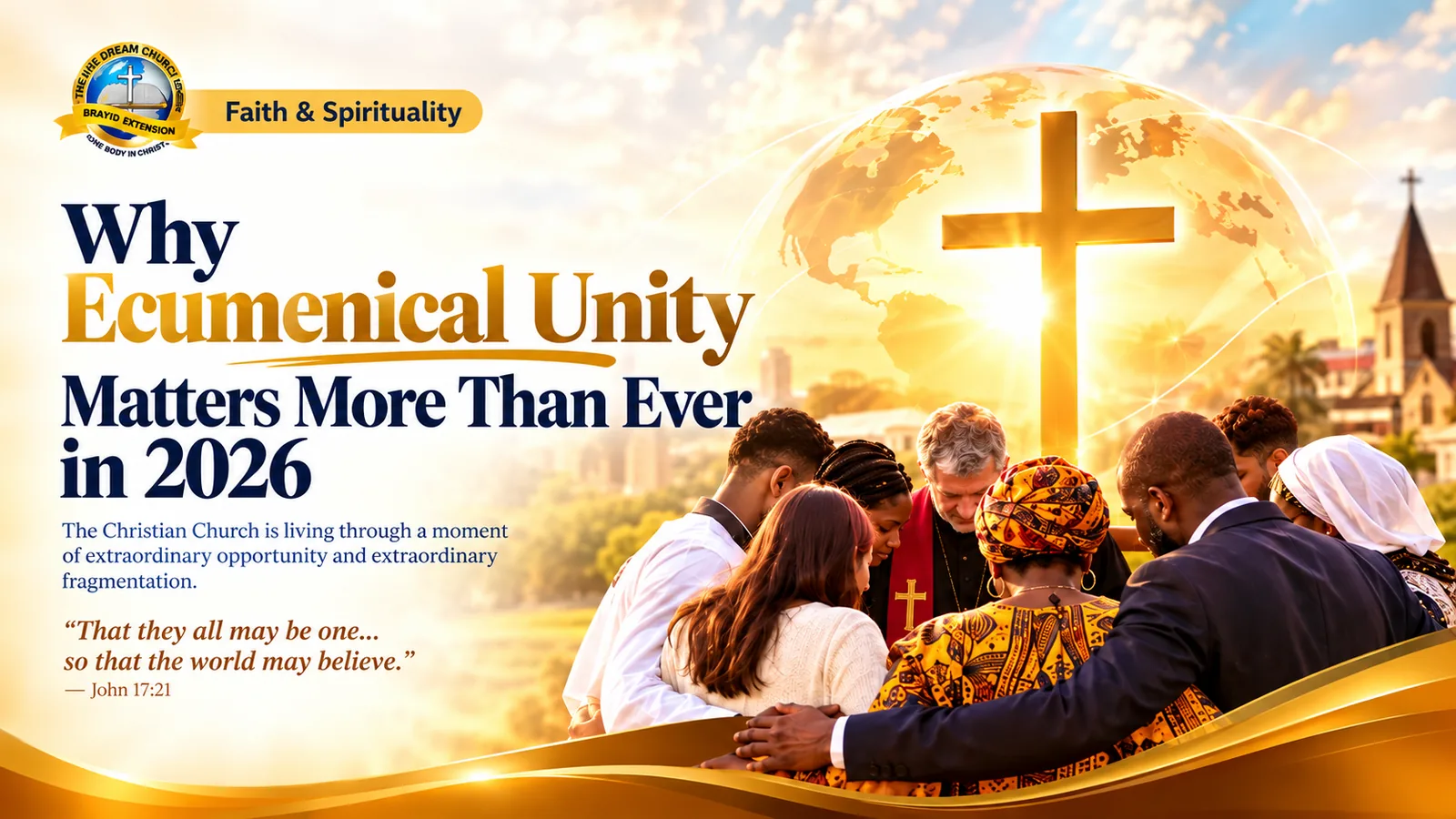
Why Ecumenical Unity Matters More Than Ever in 2026
The Christian Church is living through a moment of extraordinary opportunity and extraordinary fragmentation.
That they all may be one… so that the world may believe. — John 17:21
Reflection 01
Unity in an age of fragmentation
The Christian Church is living through a moment of extraordinary opportunity and extraordinary fragmentation. Across nations, generations and denominations, Christians are asking important questions about identity, mission, culture, leadership and the future of the Church. At the same time, society itself is becoming increasingly divided. Political disagreements, cultural tensions, generational differences, migration, technology and competing worldviews can easily create walls between people. In such an environment, ecumenical unity is not merely an institutional idea for church leaders to discuss at conferences. It is a spiritual responsibility and a visible expression of the Gospel.
Reflection 02
One body, many faithful traditions
Ecumenical unity does not mean that every church must become identical. Christian traditions have different histories, worship styles, theological emphases and structures. Unity does not require the elimination of legitimate diversity. Rather, it asks whether Christians can recognise what they hold in common while learning to live faithfully with differences that do not prevent fellowship and mission. The New Testament presents the Church as one body with many members. The challenge for the Church today is learning how to embody that reality without allowing denominational identity to become more important than Christian identity.
Reflection 03
A fellowship formed in the diaspora
The need for unity becomes particularly visible in the diaspora. African and Caribbean Christians in Britain represent a rich tapestry of traditions, denominations, languages, worship expressions and theological experiences. Some congregations are Pentecostal, some Anglican, some Methodist, Baptist, independent, Aladura or rooted in other traditions. Yet beneath those differences are shared experiences of migration, faith, family, community and the desire to proclaim Christ in a changing society. Organisations such as the Council of African and Caribbean Churches UK demonstrate how independent churches can retain their identity while working together around shared purposes. The Council describes itself as a fellowship rather than a hierarchy, serving churches without governing them.
Reflection 04
When the world watches the Church
Unity also matters because the world is watching how Christians treat one another. A Church that preaches reconciliation but cannot cooperate across denominational, cultural or generational boundaries weakens its own witness. Jesus' prayer in John 17 places remarkable emphasis on the unity of His followers. The purpose is not simply that Christians feel comfortable together; unity is connected to witness. When believers demonstrate that Christ can bring different people into genuine fellowship, the Church offers society a picture of reconciliation that cannot easily be dismissed as theory.
Reflection 05
From ecumenical language to shared life
In 2026, unity must also become practical. It cannot remain a word used in conference themes, anniversary celebrations or ecumenical statements. Churches can demonstrate unity by sharing training opportunities, supporting vulnerable congregations, collaborating on community projects, praying together, mentoring young ministers, responding collectively to social needs and creating opportunities for congregations to know one another. Sometimes unity begins with something as simple as a pastor calling another pastor to ask, "How can we help one another?" Relationships often accomplish what formal structures cannot.
Reflection 06
The humility that makes unity possible
Another important lesson is that unity requires humility. Churches cannot genuinely pursue Christian fellowship while assuming that their own tradition has nothing to learn from anyone else. The Church becomes stronger when leaders listen. Older generations have wisdom that younger generations need, while younger Christians often bring perspectives about technology, culture, communication and contemporary society that older leaders need to hear. African and Caribbean churches also have much to learn from historic British denominations, just as established British churches can learn from the spirituality, community structures, missionary passion and worship traditions of diaspora congregations.
Reflection 07
Together before challenges too large for one church
Unity is especially important when the Church faces challenges that are bigger than any individual congregation. Questions surrounding poverty, loneliness, migration, racism, family breakdown, youth disengagement, mental wellbeing, homelessness and community cohesion cannot always be addressed effectively by churches working in isolation. Collaboration allows congregations to combine resources, expertise and relationships. The goal is not to build a larger institution for its own sake, but to create a stronger Christian response to the needs of real people.
Reflection 08
Christ at the centre
Ultimately, ecumenical unity begins with a theological conviction: Christ is greater than our denominational labels. Our traditions matter, but they are not the centre of the Gospel. The centre is Christ. When churches remember this, cooperation becomes less threatening. We can remain rooted in our convictions while making room for fellowship, partnership and mutual respect. In a fragmented age, the Church's unity can become one of its most powerful forms of witness. The question for 2026 is therefore not simply whether Christians believe in unity, but whether we are willing to practise it.